There are no items in your cart
Add More
Add More
| Item Details | Price | ||
|---|---|---|---|


Instructor: Prof. Deepanshu Mohan and Najam Us SaqibLanguage: English
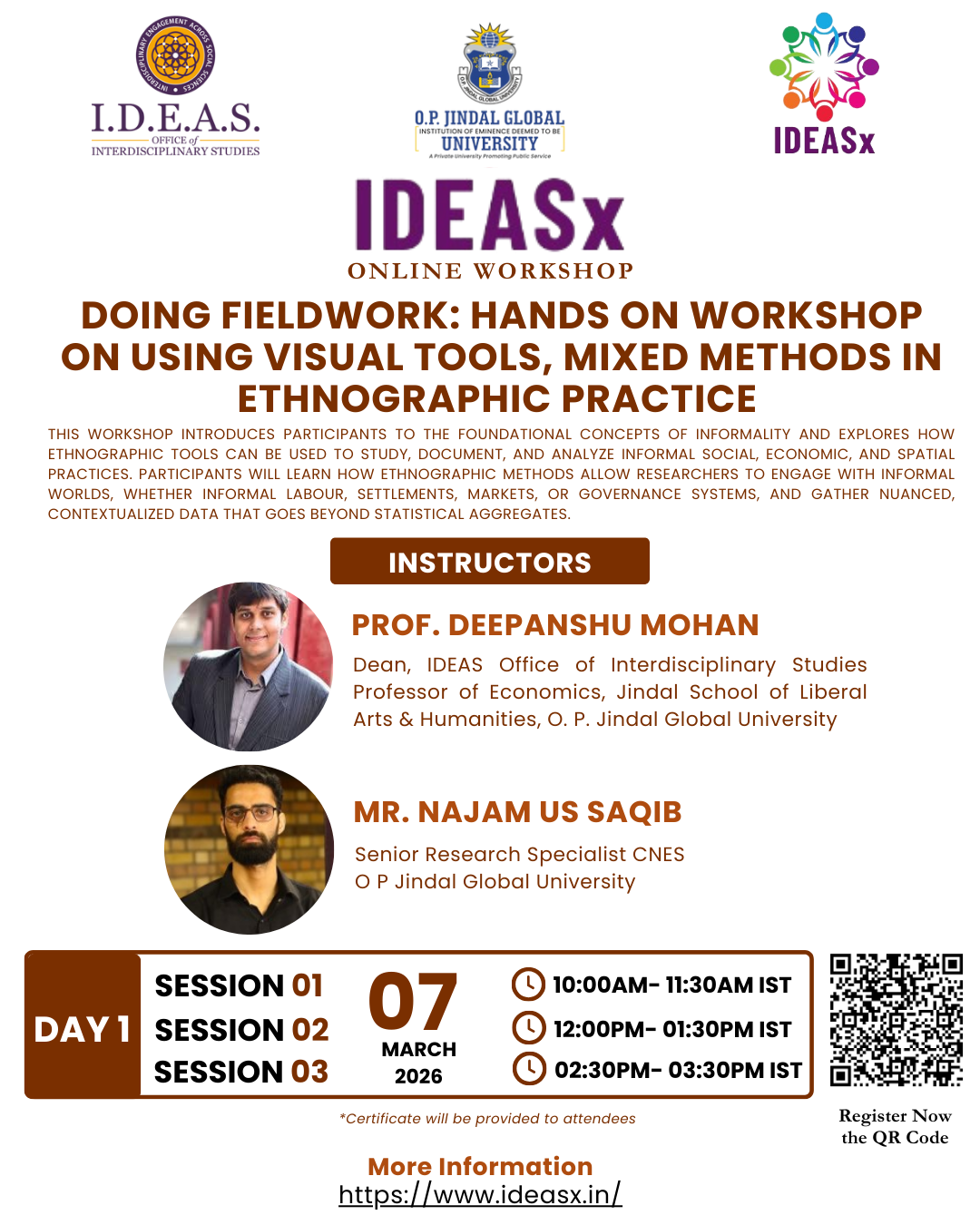
This workshop introduces participants to the foundational concepts of informality and explores how ethnographic tools can be used to study, document, and analyze informal social, economic, and spatial practices. Participants will learn how ethnographic methods allow researchers to engage with informal worlds, whether informal labour, settlements, markets, or governance systems, and gather nuanced, contextualized data that goes beyond statistical aggregates.
Session 1: Conceptualising Informality
Session Time: 10:00 a.m.- 11:30 a.m.
Session Focus
Session 3: Participant Presentations & Peer Discussion, Session Time: 2:00 p.m. - 3:30 p.m.
Session Focus
Who Can Benefit
Students, early-career researchers, practitioners, and social scientists who:
· Are working on topics involving informal economies, labour, housing, or governance
· Seek qualitative tools to complement mixed methods research
Prerequisites
Basic familiarity with social research concepts
No prior training in ethnography is necessary
Certificate
Participants will receive an e-certificate upon attending at least 70% of the workshop and presenting in the final session.
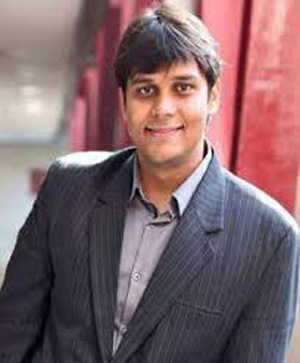
Dean, IDEAS Office of Interdisciplinary Studies Professor of Economics,
Jindal School of Liberal Arts & Humanities, O. P. Jindal Global University
Deepanshu Mohan is Professor of Economics and Dean, IDEAS, Office of InterDiscplinary Studies, O.P. Jindal Global University (JGU), India. His teaching affiliation for taught courses in areas of comparative political economy, development studies, research methods, is with the Jindal School of Liberal Arts and Humanities at the University (JGU), where he is also Director, Centre for New Economics Studies (CNES), and Senior Research Fellow, International Institute of Higher Education (IIHED). Prior to visiting Oxford University this Fall as a Visiting Fellow at the Asian and Middle Eastern Studies (AMES), Prof. Mohan has been a Visiting Professor to the South East Asia Centre (SEAC) at the London School of Economics and Political Science, and at Birkbeck College’s Faculty of Social Sciences where he is also been affiliated as an Honorary Research Fellow since 2022. He is also a Visiting Fellow to the Department of Economic History, London School of Economics (LSE) for 2025-26. He has previously held visiting assignments, professorships and positions with: University of Ottawa (School of International Development, Canada); FGV (Rio de Janeiro, Brazil); Carleton University (Department of Economics, Canada); Stellenbosch University (School of Public Leadership, South Africa); CamEd Business School (Cambodia), to name a few. His research work and published research broadly intersects areas of development studies, urban studies, comparative political economy, economic anthropology, public law, comparative economic thought. He is published with: Routledge, Taylor and Francis (London and New York); Elsevier; Oxford University Press (OUP) London; Cambridge University Press; NUS Singapore; Brill; Palgrave MacMillan, Springer Nature, to name a few.
Senior Research Specialist CNES, Program Manager at IDEAS, O P Jindal Global University
Venue
Online,
IDEASx Platform
Saturday - 7 March. 2026:
Session 1: 10:00 AM to 11:30 AM
Session 2: 12:00 PM to 1:30 PM
Session 3: 2:00 PM to 3:30 PM
STAY UPDATED
Follow us on:
Instagram: @jgu_ideas
Twitter: @jguideas
Linkedin: @I.D.E.A.S. Office of Interdisciplinary Studies
 Launch your Graphy